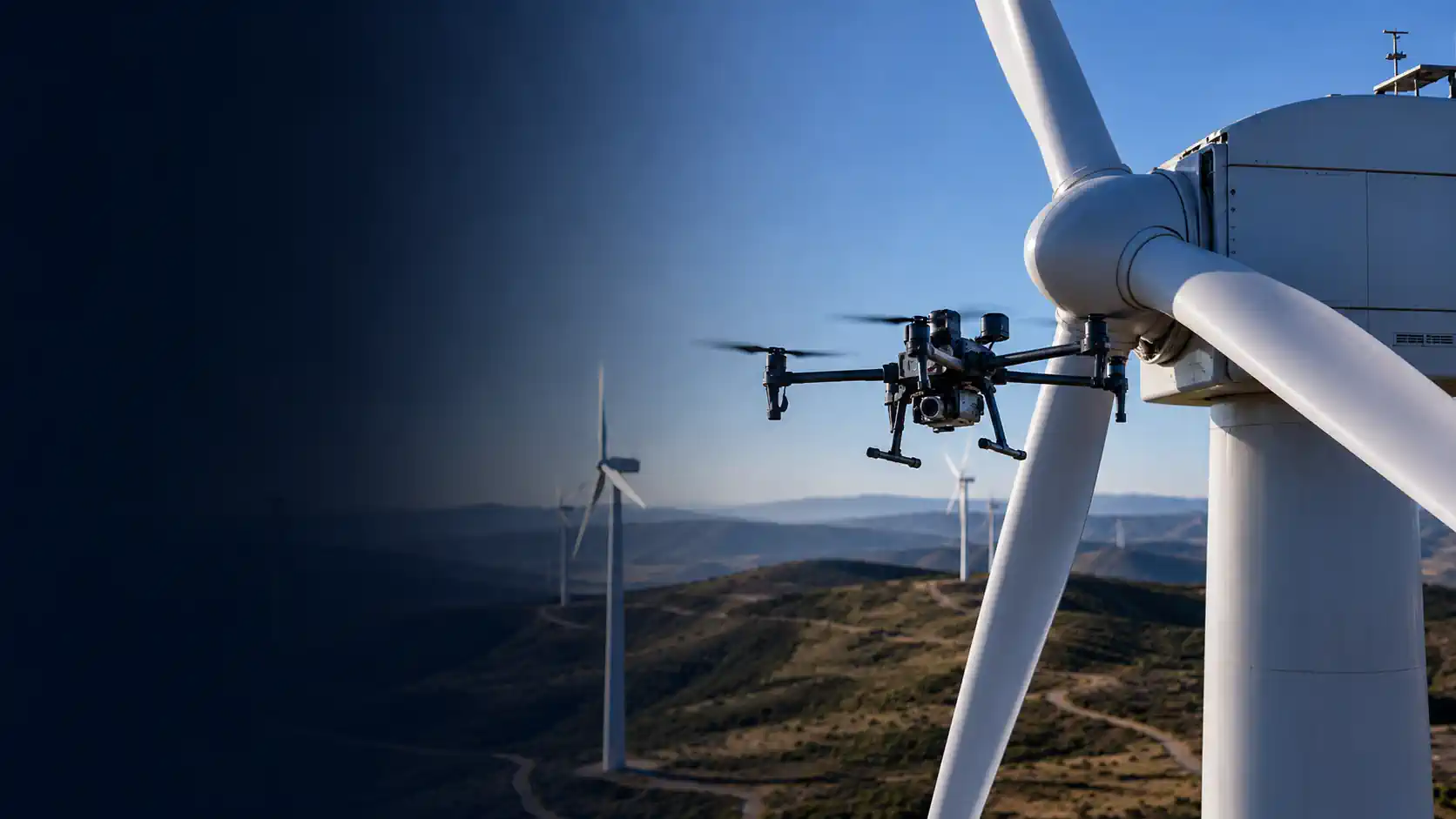
Wind Turbine Inspection Drones
Find a ready-to-deploy solution built for the way you work.
Select the Right Drone System
Describe what you need the drone system to do, or use our guided selector.
Loading selector...
Roof Inspection Drones
Find a ready-to-deploy solution built for the way you work.
Select the Right Drone System
Describe what you need the drone system to do, or use our guided selector.
Loading selector...
Wind Turbine Inspection Drones for Different Inspection Workflows
Wind turbine inspections require controlled image capture around tall structures, long blades, curved surfaces, and components exposed to changing wind and lighting conditions.
A system used for occasional visual inspection of a single onshore turbine may not be suitable for documenting an entire wind farm. Larger inspection programs may require optical zoom, repeatable automated flight paths, accurate positioning, standardized image coverage, extended battery support, and software that organizes findings by turbine and blade location.
Read More
Nonadrone helps you compare ready-to-deploy wind turbine inspection drone systems based on the asset, required defect visibility, operating distance, sensor type, site conditions, inspection frequency, and reporting workflow.
What Wind Turbine Inspection Drones Can Document
High-resolution drone imagery can help inspection teams document visible conditions without requiring technicians to access every exterior section of the turbine directly.
Depending on the payload and collection method, a drone system may help document:
- leading-edge erosion;
- visible cracks and surface damage;
- coating deterioration;
- chipped or missing material;
- lightning-related surface damage;
- contamination and debris;
- damage around blade tips and edges;
- visible defects near joints, seams, and attachment areas;
- corrosion or coating damage on towers;
- exterior conditions around the nacelle and hub;
- changes observed across recurring inspections.
Aerial imagery cannot confirm every structural or internal defect. Suspected damage may require engineering review, rope-access inspection, ultrasonic testing, internal blade inspection, or another nondestructive testing method.
Wind Turbine Blade Inspections
Blade inspections require detailed and consistent imagery across large, curved surfaces. A useful dataset must show not only the suspected defect but also its position on the blade.
The inspection may need to document:
- pressure and suction sides;
- leading and trailing edges;
- blade root;
- blade tip;
- surface around previously recorded damage;
- recurring conditions across multiple inspections.
Camera resolution alone does not determine whether small defects will be visible. Image detail also depends on optical zoom, lens characteristics, distance from the blade, image focus, aircraft movement, lighting, blade position, and surface contrast.
A suitable system should capture the required detail from a practical operating distance without relying on excessive digital enlargement after the flight.
Tower, Nacelle, and Hub Inspections
Wind turbine inspections are not limited to blades. Visible imagery may also be used to document exterior conditions on the tower, nacelle, hub, access platforms, ladders, vents, fasteners, and other accessible components.
Tower inspections may focus on:
- corrosion and coating deterioration;
- visible cracks or surface damage;
- seams and flange areas;
- staining or possible fluid leakage;
- external cables and attachments;
- access doors and platforms.
Nacelle and hub inspections may require several controlled viewing angles and optical zoom. The drone must remain stable enough to capture focused images while operating near a large structure that can influence local airflow.
External drone imagery does not replace internal mechanical, gearbox, generator, electrical, or lubrication-system inspection.
High-Resolution Cameras and Optical Zoom
Visible imaging is the primary capability for most external wind turbine drone inspections.
A high-resolution camera can capture broad blade and tower conditions. Optical zoom provides additional detail when the aircraft must maintain a greater distance from the turbine or when a smaller component needs to be documented.
The required camera configuration depends on:
- smallest defect that must be visible;
- distance from the turbine;
- blade dimensions;
- acceptable inspection time;
- wind conditions;
- required image coverage;
- software and reporting requirements.
Digital zoom crops and enlarges existing image data. It does not preserve detail in the same way as suitable optical zoom and correct image capture at the source.
Thermal Imaging for Wind Turbine Inspections
Thermal cameras may support specific wind turbine inspection tasks, but they should not be treated as a universal replacement for detailed visible imaging.
Depending on the component, operating state, environmental conditions, and inspection objective, thermal imagery may help identify surface temperature differences requiring further investigation.
Radiometric thermal capability may be needed when the workflow requires retained temperature data rather than only a live thermal view.
Thermal results can be affected by:
- solar heating;
- wind;
- ambient temperature;
- surface emissivity;
- reflections;
- viewing angle;
- turbine operating condition;
- time elapsed after shutdown.
A thermal anomaly does not independently confirm the type or severity of a defect. Results should be interpreted alongside visible imagery, operating data, maintenance history, and any required follow-up testing.
Manual and Automated Turbine Inspections
Manual flight may be appropriate for targeted inspections, follow-up documentation, irregular turbine geometry, or closer review of a known condition.
Automated or assisted inspection missions may be more suitable when operators need:
- consistent blade coverage;
- standardized image angles and distance;
- repeatable inspections across multiple turbines;
- systematic naming and organization of imagery;
- comparison with previous inspection records;
- shorter setup time between similar assets;
- structured data for automated or assisted defect review.
Automation does not remove the need for site planning or operator oversight. Turbine condition, blade position, surrounding terrain, obstacles, wind, communications, and local procedures still determine whether a planned mission can be completed safely.
Wind, Turbulence, and Site Conditions
Wind turbine sites can expose an aircraft to changing wind speed, gusts, turbulence, and localized airflow around blades, towers, and nacelles.
Maximum published wind resistance should not be treated as the normal operating target. Image sharpness, aircraft position, available battery reserve, return flight, and sudden changes in conditions must also be considered.
Other site factors may include:
- steep or uneven terrain;
- limited takeoff and landing areas;
- nearby turbines and electrical infrastructure;
- roads, workers, and service vehicles;
- poor communications coverage;
- cold, heat, moisture, dust, or salt exposure;
- restricted access to the inspection area.
The selected system should be evaluated for the actual site rather than only against manufacturer endurance and wind-resistance figures.
Onshore and Offshore Wind Turbine Inspections
Onshore wind farms may require portable equipment, reliable vehicle transport, field charging, and efficient deployment across turbines separated by significant distances.
Offshore operations introduce additional requirements. These may include launch and recovery from a vessel or platform, salt exposure, limited landing space, stronger and less predictable wind, communications limitations, and reduced opportunities to recover an aircraft after a failure.
A system suitable for an onshore turbine should not automatically be assumed suitable for offshore deployment. Environmental protection, operating procedures, aircraft redundancy, support equipment, crew experience, and recovery planning must be assessed separately.
Inspection Software and Defect Tracking
Flight software controls the aircraft and image collection, but professional wind turbine inspections may require additional software to organize and review the resulting data.
Compatible software may be used to:
- assign imagery to a specific turbine;
- identify the blade and blade surface;
- record the position of a finding along the blade;
- compare current and previous inspections;
- annotate visible damage;
- classify and prioritize findings;
- manage inspection history;
- generate reports for maintenance teams or asset owners;
- export data to asset-management systems.
Software compatibility should be verified for the aircraft, camera, image metadata, inspection method, and required deliverable. A large collection of high-resolution images has limited operational value if findings cannot be connected to the correct turbine and blade location.
Ready-to-Deploy Wind Turbine Inspection Solutions
The systems presented on this page are evaluated as complete working solutions rather than standalone aircraft.
Depending on the selected configuration, a solution may include:
- the drone platform;
- high-resolution visible or optical-zoom payload;
- thermal or combined sensor payload;
- batteries and field charging equipment;
- controller and operator display;
- flight and mission-planning software;
- compatible blade inspection, thermal analysis, or reporting software;
- positioning accessories;
- transport and storage equipment;
- setup, training, warranty, and manufacturer support.
Each product page identifies the included equipment, compatible professional software, available options, and components or licenses that must be purchased separately.
Final configuration should be confirmed for the turbine type, blade dimensions, required defect visibility, operating distance, site conditions, inspection volume, and reporting workflow.
Commercial Operating Requirements
Commercial wind turbine inspection flights must comply with the requirements applicable to the pilot, aircraft, airspace, site, and proposed mission.
A turbine owner’s permission to inspect the asset does not replace FAA operating requirements, controlled-airspace authorization, or permission to use the required takeoff and landing area.
Inspection height must also be evaluated carefully. Standard altitude rules include specific provisions for operations near structures, but the exact mission must still remain within the applicable operating limits and visual-line-of-sight requirements.
Requirements should be confirmed for the turbine location, aircraft, crew, inspection height, and intended flight method before the system is placed into service.
Wind Turbine Inspection Drone FAQ
Most external inspections use a stable multirotor drone equipped with a high-resolution visible camera. Optical zoom, thermal capability, automated inspection routes, longer endurance, or specialized software may be required depending on the turbine, defect size, operating distance, and inspection volume.
Optical zoom is useful when small surface conditions must be documented while maintaining greater distance from the blade. The required zoom depends on defect size, camera resolution, blade dimensions, wind conditions, and the distance at which the aircraft can collect stable images.
Optical zoom is useful when small surface conditions must be documented while maintaining greater distance from the blade. The required zoom depends on defect size, camera resolution, blade dimensions, wind conditions, and the distance at which the aircraft can collect stable images.
The acceptable turbine state depends on the inspection method, site procedure, aircraft capability, and asset owner’s requirements. Detailed and repeatable blade imaging commonly requires a controlled blade position. The inspection plan should be coordinated with the turbine operator before flight.
A single aircraft may inspect multiple turbines, but daily capacity depends on turbine size, required image detail, flight time, battery rotation, travel between assets, wind, data transfer, and inspection procedure. The number of turbines cannot be determined from advertised flight time alone.
Use the Nonadrone selector to specify whether you inspect blades, towers, nacelles, individual turbines, or complete wind farms.